
Developing strong social skills in kindergarten children lays the foundation for healthy relationships, emotional resilience, and future academic success. When educators and parents work together on building social skills in kindergarten children, children feel more confident, cooperative, and ready to thrive in group settings.
What are social skills in kindergarten?
Building social skills in kindergarten children means helping them learn how to communicate, share, take turns, listen, express feelings, and solve small conflicts respectfully. These early skills support friendship building, classroom participation, and a positive attitude towards school.
School supplies
Key social skills for kindergarten include:
- Sharing toys and materials
- Taking turns and waiting patiently
- Listening when others speak
- Using polite words like “please,” “sorry,” and “thank you”
- Managing big emotions in acceptable ways
- Working together in pairs and small groups
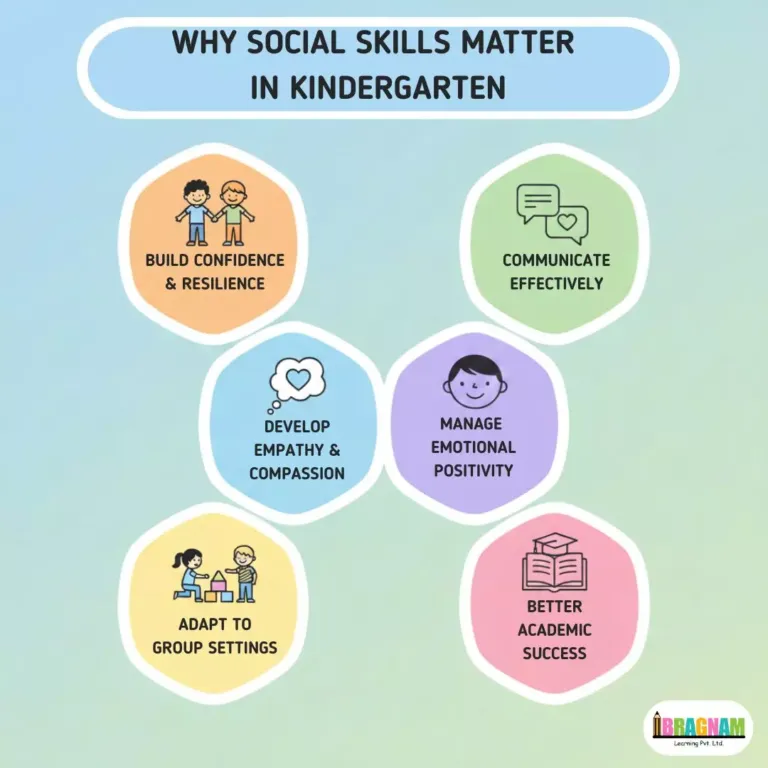
Why building social skills in kindergarten children matters
Focusing on building social skills in kindergarten children is just as important as teaching letters and numbers. Children with stronger social skills usually adjust better to school routines, make friends more easily, and show fewer behaviour problems over time.
Some key benefits are:
- Better communication: Children learn to express needs, ask for help, and share ideas clearly.
- Stronger emotional health: Social skills help children cope with stress, disappointment, and change more effectively.
- Positive relationships: Skills like empathy, cooperation, and kindness support lasting friendships and teamwork.
- Improved learning: When children can listen, follow directions, and work with peers, classroom learning becomes smoother and more effective.
Core social skills to nurture in kindergarten
Communication and listening skills
Building social skills in kindergarten children starts with simple, everyday conversations. When children talk, listen, and respond to others, they learn how to respect different opinions and express themselves with confidence.
Ways to support communication:
- Encourage children to use full sentences instead of pointing or shouting.
- Model polite greetings like “Good morning” and “How are you?” in class and at home.
- Use circle time to let each child share one thought, while others practise listening without interrupting.
Sharing, turn-taking, and cooperation
For many children, kindergarten is the first place where they must share space, toys, and adult attention with many peers. Building social skills in kindergarten children here means teaching them that everyone gets a turn and that working together can be fun.
Helpful strategies:
- Use games with clear “my turn/your turn” rules, such as board games or passing a “talking object.”
- Praise specific cooperative behaviour: “You waited your turn very patiently” rather than only saying “good job.”
- Set up small-group activities where children must build, sort, or complete a task together, instead of competing.
Emotional awareness and empathy
Another major part of building social skills in kindergarten children is helping them recognise their own feelings and understand others’ emotions. Children who can name feelings like happy, sad, angry, or scared are better able to calm down and respond kindly to others.
Practical ideas:
- Use emotion cards or a feelings chart so children can point to how they feel each morning.
- Pause during storytime to ask, “How do you think this character feels?” and “What would you do in this situation?”
- Acknowledge emotions: “You are upset because you wanted that toy; let’s find another way,” instead of only saying “Stop crying.”
Problem-solving and conflict resolution
Disagreements about toys, turns, or rules are normal in kindergarten. Building social skills in kindergarten children means teaching them peaceful ways to solve these small conflicts. When guided well, these moments become powerful learning opportunities.
Simple conflict-resolution steps:
- Stop and calm down (deep breath, quiet corner, or counting slowly).
- Let each child say what happened in their own words.
- Help them name the problem: “We both want the same toy.”
- Brainstorm solutions together: “Take turns,” “play together,” or “choose a different toy for now.”
- Agree on a plan and appreciate their effort to solve it peacefully.
Practical classroom strategies for building social skills
Daily routines that build social skills
Routines give young children a sense of safety and predictability, making social learning easier. When building social skills in kindergarten children, simple daily rituals can be turned into social-emotional lessons.
Ideas to include in the day:
- Morning greetings at the door: handshake, wave, or namaste to build connection.
- Circle time check-ins: each child shares “one good thing” or “one feeling” from home or school.
- Helper-of-the-day roles: line leader, board cleaner, book helper, which teach responsibility and teamwork.
Play-based activities to build social skills
Play is one of the most effective tools for building social skills in kindergarten children, as children learn naturally while playing. Structured and unstructured play both offer rich chances for sharing, negotiation, and cooperation.
School supplies
Useful play ideas:
- Role-play corners: “home,” “doctor,” “shop,” or “school” where children practise conversation, turn-taking, and problem-solving.
- Cooperative games like “Balloon Bop” or parachute play, where the group must work together instead of competing.
- Group art projects such as a big mural or group sculpture, where each child contributes a part to a shared creation.
How parents can support social skills at home
Building social skills in kindergarten children works best when home and school move in the same direction. Parents can create small daily habits that mirror what children learn in the classroom.
Simple home practices:
- Ask open-ended questions like “What did you play with your friends today?” instead of only “How was school?”
- Arrange playdates or small group activities so children can practise sharing and taking turns outside school.
- Model respectful behaviour by saying “please,” “sorry,” and “thank you” at home, and handling conflicts calmly.
- Involve children in age-appropriate chores like setting the table or tidying toys, to build responsibility and teamwork.
Frequently asked questions about building social skills in kindergarten children
1. Why is building social skills in kindergarten children more important than academics?
Kindergarten teachers consistently report that social and emotional readiness matters more than early academic scores for a smooth school start. When children can listen, share, follow directions, and manage emotions, they learn reading and math more easily later.
2. How can shy children improve their social skills in kindergarten?
Begin with small, low-pressure interactions such as partnering with one gentle classmate instead of large groups. Teachers and parents can role-play simple phrases like “Can I play with you?” to build confidence and reduce anxiety.
3. How long does it take to see progress in social skills?
Building social skills in kindergarten children is a gradual process that develops over months, not days. With consistent routines, gentle reminders, and positive reinforcement, most children show noticeable improvements across the school year.
School supplies
4. What should teachers do if a child often fights or grabs toys?
Instead of labelling the child as “naughty,” teachers can treat each incident as a teaching moment to practise turn-taking and problem-solving. Clear rules, visual supports like “my turn/your turn” cards, and praising small improvements are very effective.
5. How can parents know if their child needs extra help with social skills?
Warning signs include frequent conflicts, inability to play in groups, extreme withdrawal, or constant aggressive behaviour for a long period. In such cases, families should talk to the class teacher, school counsellor, or a paediatric professional for guidance and support.
School supplies
Call-to-action: Let’s focus on building social skills in kindergarten children
When schools and families make building social skills in kindergarten children a priority, children grow into confident, kind, and cooperative learners. Encourage your teachers and parents to start with small daily routines, simple games, and open conversations that help children connect, communicate, and care for others. Invite your school community to share their favourite social skill activities, success stories, or classroom ideas, and turn your kindergarten into a strong, supportive social learning space.