
Chess Openings decoded: secrets to a strong start is all about turning those confusing first moves into a simple, clear plan you can follow in every game. When your opening makes sense, you feel calmer, your pieces develop smoothly, and you avoid the early blunders that lose games in just 10 moves.
This guide breaks down the secrets behind strong chess openings in plain language, so beginners, kids, parents, and casual players can use them right away—without memorizing long, scary theory.
Why openings matter
A strong start sets the tone for the entire game. Good chess openings help you reach safe, active positions where your pieces work together and your king is protected.
When you understand Chess Openings decoded: secrets to a strong start, you stop guessing moves and start playing with purpose from move one.
What a “strong start” really means
A strong start in chess is not about fancy traps; it is about simple, repeatable habits:
- Your pieces come out quickly and actively.
- Your king becomes safe through early castling.
- You fight for space and control in the center of the board.
- You avoid unnecessary pawn moves and repeated moves with the same piece.
These basics give you a solid platform for the middlegame, where tactics and strategy decide the result.
The four golden opening principles
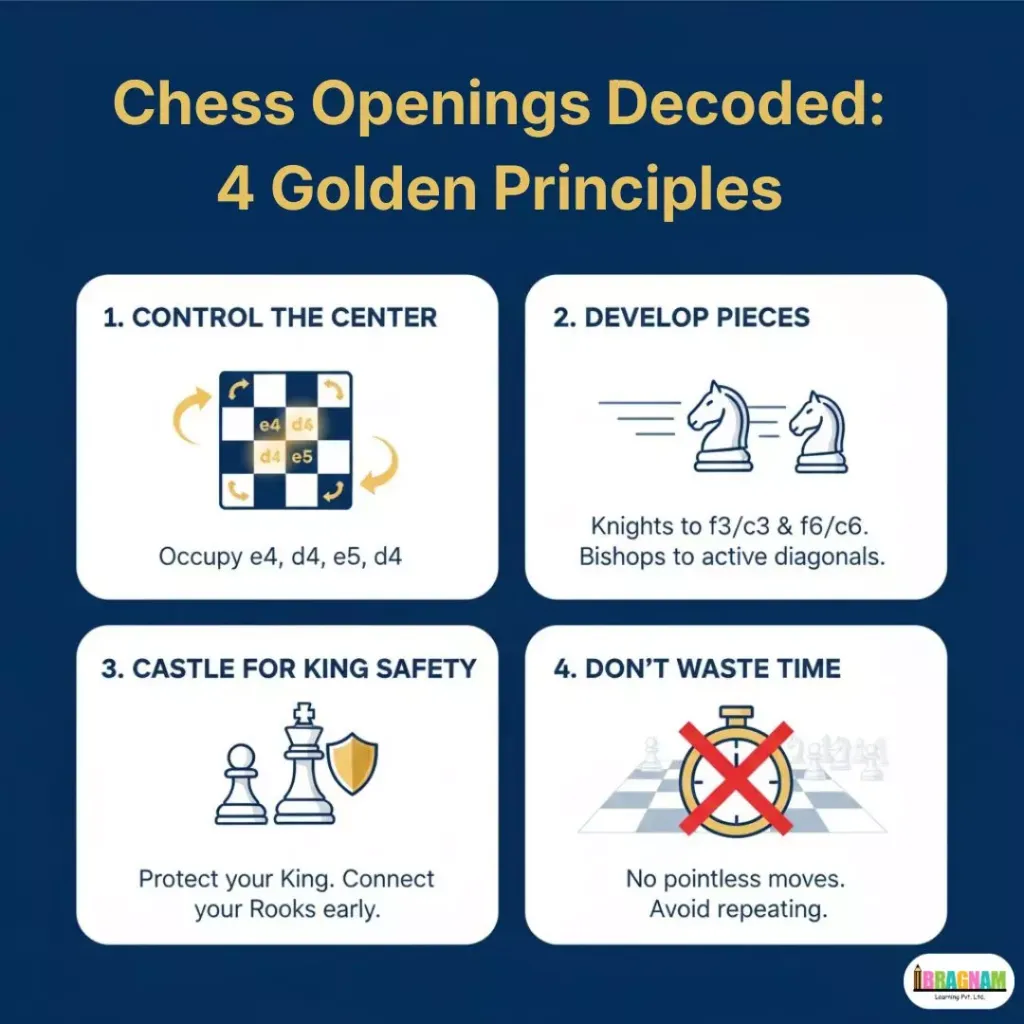
Chess Openings decoded: secrets to a strong start can be summed up in four golden principles that nearly every coach teaches to beginners.
1. Control the center
The center squares e4,d4,e5,d5 are the heart of the board. Controlling them makes your pieces more powerful and restricts your opponent’s plans.
- Good first pawn moves: 1.e4 or 1.d4 for White.
- Avoid side pawn moves like 1.a4 or 1.h4 that do not help your development.
2. Develop minor pieces early
Your knights and bishops (minor pieces) should come out quickly toward the center, not sit on their starting squares.
- Bring knights to f3/c3 (for White) or f6/c6 (for Black) as early as possible.
- Place bishops on active diagonals where they influence the center (for example, c4, g5, b5 for White).
3. Castle for king safety
One of the biggest secrets to a strong start is not leaving your king in the center for too long.
- Castle kingside early in most games to protect your king and connect your rooks sooner.
- Avoid moving too many pawns around your king before castling; that can create weak squares.
4. Do not waste time
In the opening, every tempo (move) is valuable. Time wasted often turns into pressure from your opponent.
- Do not move the same piece multiple times without a clear reason.
- Do not chase pointless threats like trying to “trap” a queen too early.
- Do not make random pawn moves that do not develop pieces or control the center.
Simple openings to start using today
You do not need to know 20 moves deep in any line to benefit from Chess Openings decoded: secrets to a strong start. You only need a few basic setups that follow the principles above.
For White: easy opening choices
- King’s Pawn Opening (1.e4)
- Controls the center and opens lines for queen and bishop.
- Often leads to open, tactical positions that are easier to understand for beginners.
Queen’s Pawn Opening (1.d4)
- Builds a strong central pawn and supports long-term piece activity.
- Often leads to more strategic, closed positions where plans matter more than calculation.
- Pick one of these as your main weapon and use it consistently to really feel Chess Openings decoded: secrets to a strong start in your games.
For Black: solid replies you can trust
As Black, your job is to equalize safely and fight back in the center.
- Against 1.e4:
- 1…e5 (Open Games)
- Leads to classical openings like the Ruy Lopez and Italian Game, with natural development.
- Against 1.d4:
- 1…d5, aiming for Queen’s Gambit–type structures, gives simple, solid development.
- You do not have to memorize all the names; just remember the ideas: fight for the center, develop quickly, and castle.
Famous openings and what they teach you
Recognizing famous openings can help you decode patterns and typical plans, even if you are not a theory expert.
Ruy Lopez (Spanish Opening)
- Begins with: 1.e4 e5 2.Nf3 Nc6 3.Bb5.
Teaches you:
- Piece pressure on the knight that defends the central pawn.
- Long-term maneuvering and control, not just quick tactics.
Italian Game
- Begins with: 1.e4 e5 2.Nf3 Nc6 3.Bc4.
- Teaches you:
- How to target the weak f7/f2 squares near the enemy king.
- Quick development and open lines for tactics.
Learning just the first 5–8 moves and the main ideas of these openings already helps you live the message of Chess Openings decoded: secrets to a strong start in real games.
Common opening mistakes to avoid
Knowing what not to do is just as important as knowing the right moves.
- Moving too many pawns and not enough pieces.
- Delaying castling and leaving the king in the center.
- Hunting for early checkmates like Scholar’s Mate every game instead of developing normally.
- Grabbing “free” pawns without checking if you fall into a trap.
- If you simply avoid these mistakes and follow the four golden principles, your opening strength will jump quickly.
How to actually practice openings
Chess Openings decoded: secrets to a strong start becomes real improvement only when you practice in a focused way.
Try this simple routine:
- Choose one opening as White (for example, 1.e4) and one reply as Black (for example, 1…e5).
- Write down the first 6–8 moves you want to play in typical lines.
- Play at least 10 online or over-the-board games using only these openings.
- After each game, quickly review: Did you control the center, develop pieces, and castle on time?
- Adjust your move order slowly as you learn from your mistakes.
This habit trains your memory, builds confidence, and helps your brain recognize patterns from the very start of the game.
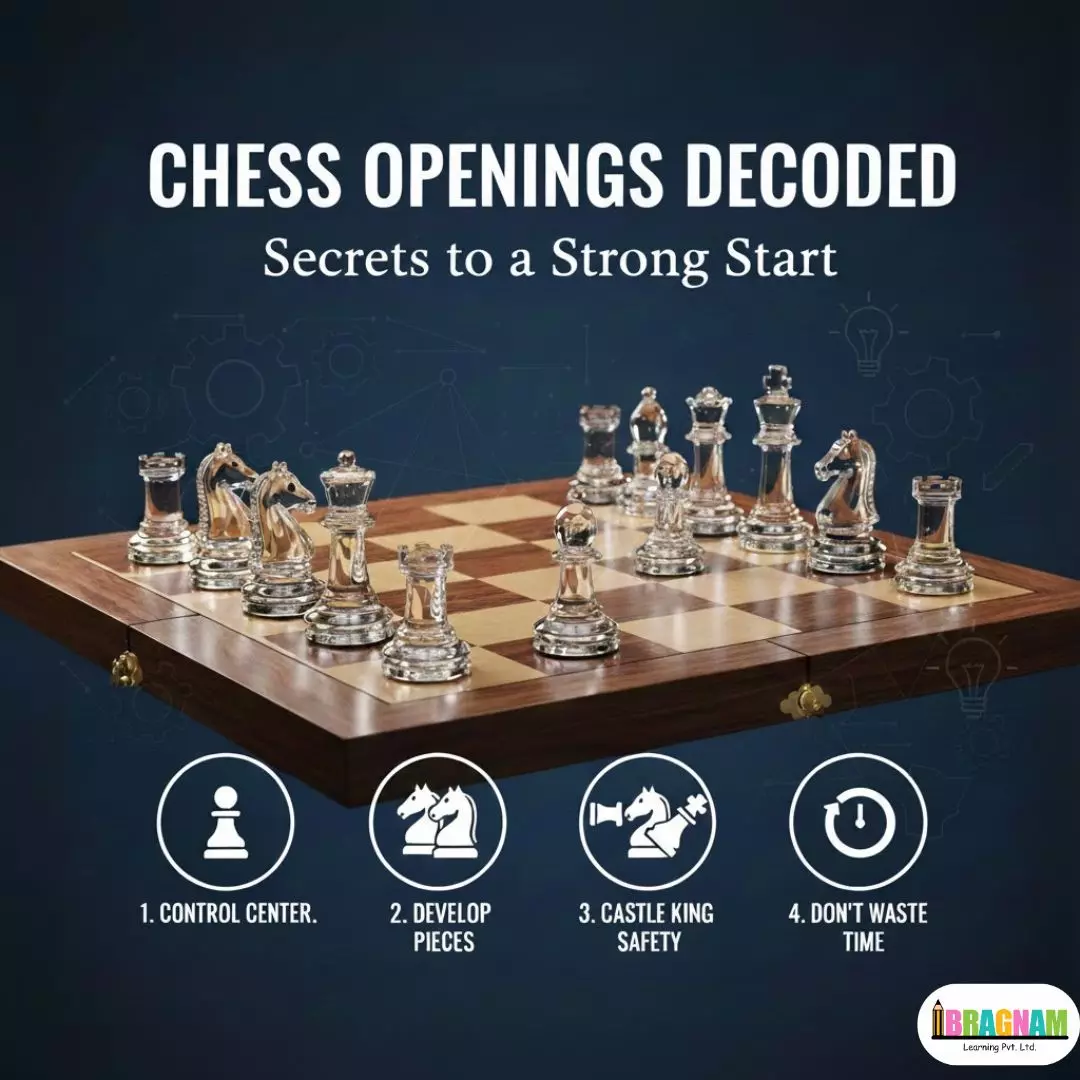
FAQ: Chess Openings decoded: secrets to a strong start
Q1. What is the best opening for beginners to start with?
For most beginners, the King’s Pawn Opening (1.e4) is an excellent choice because it controls the center and opens lines for fast development, matching the core idea of Chess Openings decoded: secrets to a strong start.
Q2. Do I need to memorize long opening lines?
No, you mainly need to understand principles like center control, development, and king safety; deep memorization can come later, while this guide keeps you focused on simple, strong habits.
Q3. How many openings should I learn at first?
Most new players improve faster by sticking to one main opening as White and one or two replies as Black so they can recognize similar positions again and again.
Q4. How do I know if my opening is “good”?
If your pieces are developed, your king is safe, and you have some control of the center after 10–12 moves without losing material, your opening has done its job.
Q5. What is the ideal way to study openings for kids or students?
Start with mini-plans like “control the center and castle by move 8,” use simple model games, and repeat the same opening structures until they feel natural to young learners.