
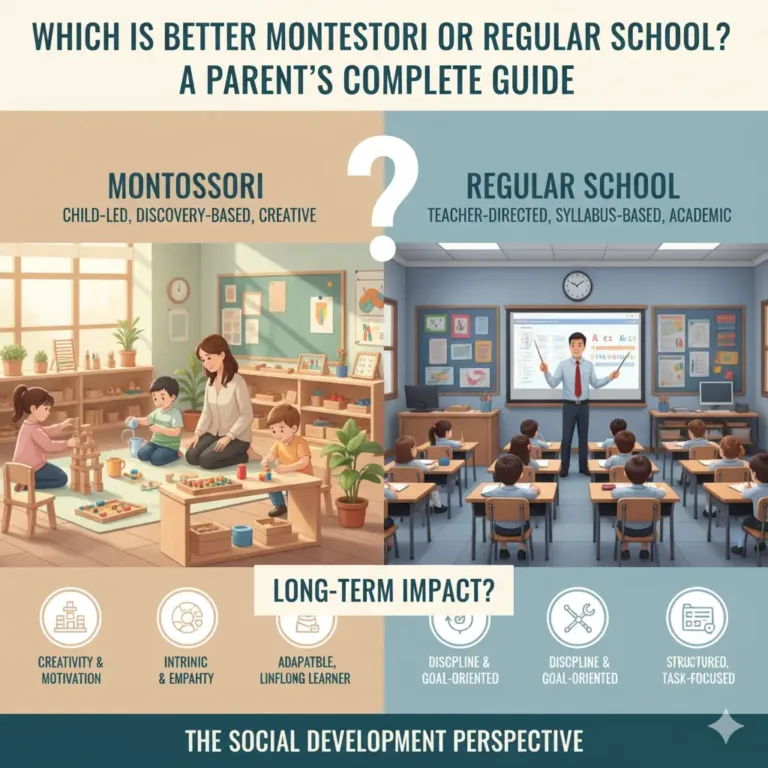
Introduction: Why Montessori belongs in your playschool
Montessori education is a child-centred approach that focuses on self-directed activity, hands-on learning, and collaborative play instead of rote teaching. In a Montessori-inspired playschool, children are seen as naturally eager to learn and capable of choosing meaningful activities when the environment is thoughtfully prepared.
For playschool owners and educators, embracing Montessori is not about changing everything overnight; it is about gradually creating a space where independence, curiosity, and respect guide every decision. This shift not only improves daily classroom life but also lays a powerful foundation for lifelong learning skills such as problem-solving, focus, and emotional resilience.
What is the Montessori method?
The Montessori method was developed by Dr. Maria Montessori, an Italian physician who observed that children learn best through exploration, movement, and purposeful work. Her approach views education as a holistic process that supports cognitive, social, emotional, and physical development together, rather than treating academics separately.
At its core, Montessori education respects each child’s pace and personality, allowing them to progress when they are ready instead of following a strict one-size-fits-all schedule. This flexibility is particularly powerful in playschools, where early experiences often shape how children feel about learning for years to come.
Key Montessori principles for your playschool
When embracing Montessori as a foundation for lifelong learning in your playschool, a few core principles will guide your planning and training. These principles can be implemented step by step, even if your school is not yet fully Montessori.
Some essential Montessori principles are:
- Respect for the child as an individual learner
- The “absorbent mind” in early childhood
- Sensitive periods for rapid learning
- A carefully prepared environment
- Auto-education (children teaching themselves through exploration)
By aligning your playschool with these principles, you create a setting where children feel trusted, capable, and motivated to take charge of their own learning journey.
The prepared environment: your silent teacher
Montessori classrooms are often described as “prepared environments” because every shelf, material, and routine is intentionally designed to support independent learning. In a playschool, this means child-sized furniture, accessible materials, and clearly defined learning areas such as practical life, sensorial, language, math, and culture.
A well-prepared Montessori environment helps children:
- Choose activities independently
- Move freely while respecting others
- Return materials to their place after use
- Develop concentration through uninterrupted work time
When your environment functions smoothly, the room itself becomes a “silent teacher,” guiding children to explore, repeat, and master skills at their own pace.
Mixed-age groups: learning from each other
Montessori playschools usually group children in mixed-age classrooms (for example, ages 3–6 together) rather than strict single-age sections. This structure mirrors real life, where different ages interact naturally, and gives each child the chance to be both learner and mentor over time.
In mixed-age Montessori groups:
- Younger children observe and imitate older peers
- Older children build confidence by helping younger ones
- Teachers can individualize lessons instead of teaching to the “average”
- A sense of community and empathy develops organically
This peer learning plays a big role in building social skills and leadership qualities that support lifelong learning and collaboration later in school and work.
Practical life activities: real skills for real life
Practical life activities are a hallmark of Montessori and fit beautifully in any playschool environment. These are everyday tasks—pouring water, buttoning, sweeping, setting the table—that children love to repeat, and that quietly build concentration, coordination, and independence.
Well-designed practical life corners help children:
- Care for themselves (dressing, washing hands, organising belongings)
- Care for the environment (watering plants, cleaning tables, arranging shelves)
- Develop fine motor skills for writing and art
- Feel proud of meaningful contributions to the classroom
When children feel capable in daily routines, they approach academic tasks with more confidence and a stronger sense of responsibility.
Well-designed practical life corners help children:
- Care for themselves (dressing, washing hands, organising belongings)
- Care for the environment (watering plants, cleaning tables, arranging shelves)
- Develop fine motor skills for writing and art
- Feel proud of meaningful contributions to the classroom
When children feel capable in daily routines, they approach academic tasks with more confidence and a stronger sense of responsibility.
Freedom within limits: gentle structure that builds discipline
One of the most powerful ideas in Montessori is “freedom within limits.” Children are free to choose activities, move around the room, and repeat work—but within clear, consistent boundaries that keep everyone safe and focused.
In a Montessori-inspired playschool, freedom within limits might look like:
- Choosing any material from a shelf, but using it in the way it was designed
- Working on the floor or at a table, but not disturbing others
- Moving around the room, but returning materials and walking carefully
This balanced approach helps children practise decision-making, self-control, and respect for others—key ingredients for lifelong learning and positive behaviour in higher classes.
The teacher as a guide, not a lecturer
In Montessori, teachers are often called “guides” because their primary role is to observe children, connect them with the right materials, and step back to let them explore. Instead of leading the entire class in the same activity, Montessori guides quietly demonstrate lessons to individuals or small groups and then allow children to practise independently.
For your playschool team, embracing this role means:
- Spending more time observing than talking
- Preparing and refreshing materials regularly
- Intervening gently only when truly necessary
- Encouraging children to solve problems on their own first
This approach nurtures confidence and intrinsic motivation, helping children develop the mindset of lifelong learners who are not afraid to try, fail, and try again.
How Montessori builds lifelong learning habits
When you bring Montessori principles into your playschool, you are doing much more than improving classroom behaviour or making your space look attractive. You are actually shaping long-term attitudes, habits, and skills that carry forward into primary school, secondary school, and adult life.
Research and school experiences show that Montessori-educated children often:
- Show stronger concentration and problem-solving skills
- Demonstrate better social-emotional skills such as empathy and self-regulation
- Display creativity and curiosity in new situations
- Maintain a genuine love for learning and exploration
These qualities prepare children not just for exams, but for real-world challenges where adaptability, collaboration, and self-motivation are essential
Practical steps to embrace Montessori in your playschool
You can start embracing Montessori in your playschool gradually, without immediately transforming into a fully certified Montessori school. Focus on small, consistent steps that align with your budget, team, and existing curriculum.
Some practical starting points include:
- Redesigning shelves so that materials are open, accessible, and neatly arranged at child height.
- Introducing a few basic Montessori-inspired practical life activities like pouring, spooning, dressing frames, and simple food preparation.
- Training teachers on observation, guiding rather than lecturing, and using gentle language that supports independence.
- Establishing longer, uninterrupted work periods where children can settle into activities without frequent transitions.
- Creating simple classroom rules that explain freedom within limits in child-friendly terms.
As your team gains confidence, you can gradually add sensorial, language, and math materials that deepen Montessori practice in your playschool.
Simple comparison: traditional vs Montessori-style playschool
| Aspect | Traditional playschool approach | Montessori-style playschool approach |
|---|---|---|
| Classroom structure | Whole-class activities led by teacher at fixed times | Children choose activities in a prepared environment at their own pace |
| Age grouping | Single-age groups (e.g., only 3-year-olds) | Mixed-age groups that learn from each other (e.g., 3–6 years) |
| Role of teacher | Instructor who explains and directs most activities | Guide who observes, introduces materials, and supports independence |
| Learning materials | Worksheets, toys, and theme-based crafts | Self-correcting, hands-on materials for practical life and academics |
| View of the child | Learners who follow instructions | Active explorers capable of self-directed learning |
| Discipline approach | External rules and rewards | Freedom within limits and self-discipline through choice |
This shift from “teaching everything” to “supporting independent learning” is what makes embracing Montessori a powerful foundation for lifelong learning in your playschool.
Conclusion: Make Montessori your playschool’s learning DNA
Embracing Montessori as a foundation for lifelong learning in your playschool is ultimately about honouring the way young children naturally learn—through exploration, choice, and meaningful work. With a prepared environment, mixed-age groups, practical life activities, and teachers who guide rather than control, your playschool can nurture children who are confident, curious, and ready to learn for life.
Instead of simply offering “school readiness,” your playschool can become a place where children discover who they are as learners—and carry that love of learning wherever they go next.
Ready to start embracing Montessori in your playschool? Begin with one classroom, one shelf, or one new routine, and watch how small changes transform children’s engagement and joy in learning.
FAQ section
1. What is Montessori and how can it fit into my playschool?
Montessori is an educational approach that focuses on self-directed learning, hands-on activities, and respect for each child’s pace of development. In your playschool, you can fit Montessori in by preparing child-friendly environments, offering practical life activities, and giving children more choice within clear limits.
2. Why is Montessori a strong foundation for lifelong learning in playschool?
Montessori builds lifelong learning skills by encouraging curiosity, concentration, and problem-solving from an early age. Children who experience Montessori often develop independence, resilience, and a genuine love for learning that supports them in later schooling and life.
3. Do I need to change my entire curriculum to embrace Montessori?
You do not need to change everything at once to embrace Montessori in your playschool. Start with small steps like reorganising the classroom, adding practical life activities, and training teachers to act more as guides than lecturers.
4. Are Montessori materials expensive for a playschool to adopt?
Some specialised Montessori materials can be costly, but many foundational practical life and sensorial activities can be created using everyday items. Playschools often begin with simple, budget-friendly setups and gradually invest in more materials as demand and resources grow.
5. How can parents see the benefits of Montessori in my playschool?
Parents usually notice that their children become more independent, responsible, and enthusiastic about coming to school. You can highlight Montessori benefits through parent orientations, classroom observations, and regular communication about how activities support lifelong learning skills.