
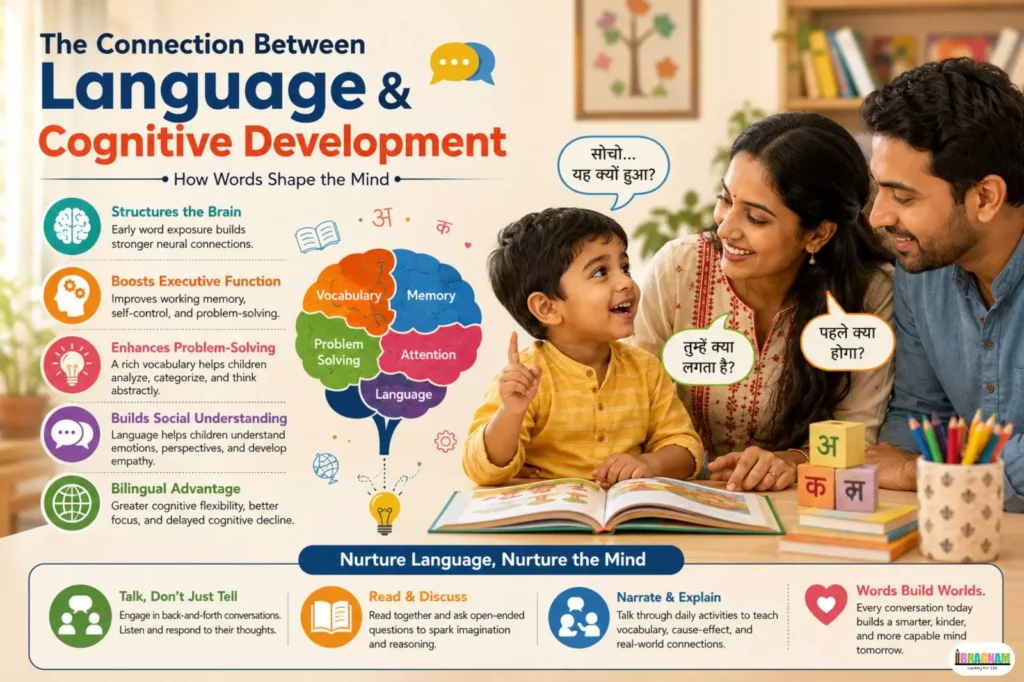
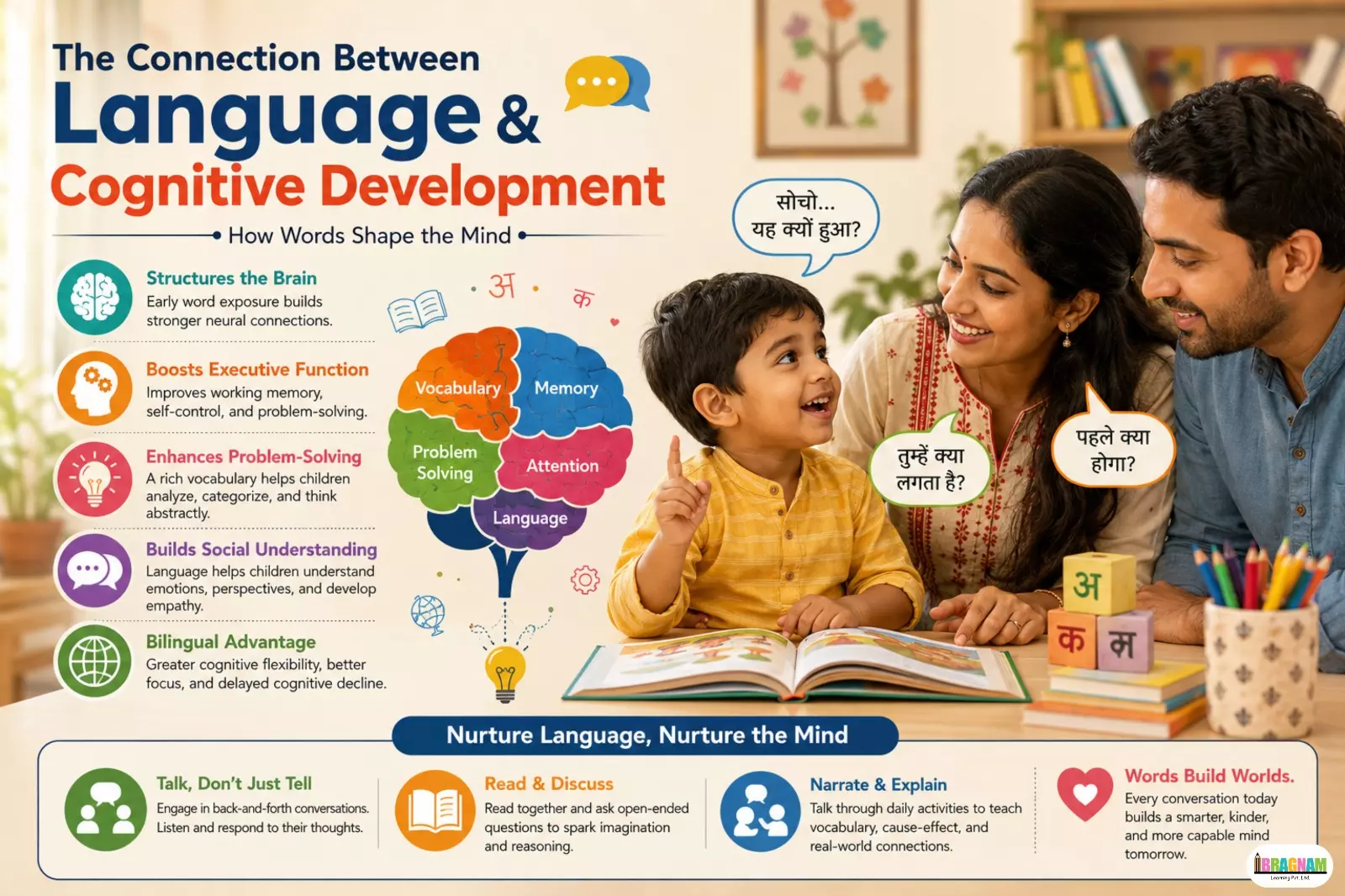
Cognitive Development: Have you ever wondered how a child transitions from simple baby babbles to solving complex problems, expressing deep emotions, and understanding the world around them? The secret doesn’t just lie in growing older; it lies in the power of words.
For decades, psychologists, linguists, and neuroscientists have studied the connection between language and cognitive development. What they discovered is fascinating: language isn’t just a tool we use to express our thoughts—it is the very scaffolding that builds those thoughts in the first place.
Whether you are a parent watching your toddler learn their first words, an educator shaping young minds, or simply curious about how the human brain works, understanding this relationship changes how you view every conversation. Let’s dive deep into how our linguistic skills directly drive our mental growth.
1. The Scaffolding of Thought: How Language Structures the Brain
When we talk about cognitive development, we are talking about how the brain processes information, learns skills, retains memories, and builds knowledge. Language acts as the primary vehicle for this entire journey.
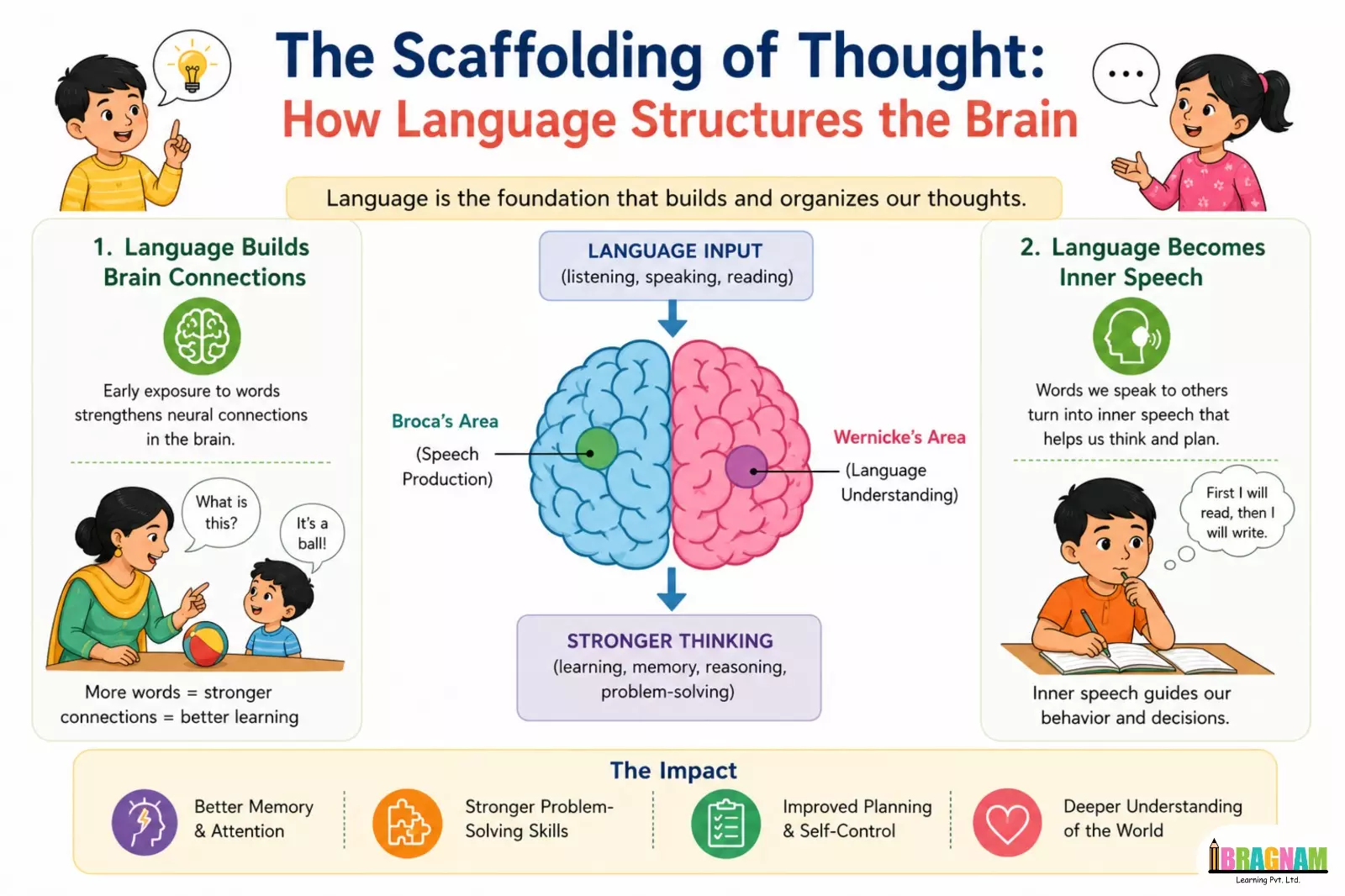
Famous psychologist Lev Vygotsky proposed that language is the most important cultural tool available to humans. He argued that children first use language socially to communicate with others, but over time, that speech turns inward. It becomes “inner speech”—our private thoughts that help us organize our behavior and reason through dilemmas.
Brain Plasticity and Early Word Exposure
During the first few years of life, a child’s brain forms more than 1 million new neural connections every second.
- The “Word Gap”: Studies show that children who grow up in language-rich environments—where parents talk, read, and engage with them frequently—develop larger vocabularies and stronger cognitive processing speeds.
- Neural Efficiency: Hearing diverse vocabulary helps train the auditory cortex and builds stronger neural pathways between the areas of the brain responsible for speech (Broca’s area) and comprehension (Wernicke’s area).
2. Executive Function: The Brain’s Control Center
One of the most critical aspects of cognitive growth is the development of executive function. Think of executive function as the air traffic control system of the brain. It manages working memory, mental flexibility, and self-control.
Surprisingly, the connection between language and cognitive development is incredibly apparent here. Language provides the labels and rules that allow executive functions to operate efficiently.
Working Memory
To solve a math problem or follow a multi-step recipe, you have to hold information in your head and manipulate it. Language allows us to “chunk” complex ideas into simpler words or phrases, freeing up mental processing power.
Inhibitory Control (Self-Regulation)
Have you ever seen a toddler talk themselves through a difficult task? “No, don’t touch, hot,” or “First the blue block, then the red block.” This is language actively acting as a brake system for the brain. By verbalizing rules, children learn to inhibit impulsive behaviors and plan their next moves.
3. The Power of Vocabulary on Problem-Solving
Your ability to solve a problem is often limited by the words you have available to describe it. Vocabulary isn’t just a list of words; it is a catalog of concepts.
“The limits of my language mean the limits of my world.” — Ludwig Wittgenstein
Consider how a rich vocabulary enhances cognitive skills:
- Categorization: A child who only knows the word “bird” groups all flying creatures together. But a child who learns the words “eagle,” “penguin,” and “sparrow” is forced to analyze characteristics, differences, and habitats. This sharpens critical thinking.
- Abstract Thinking: Words allow us to think about things that aren’t physically in front of us. Concepts like justice, tomorrow, fairness, or gravity cannot be touched—they can only be processed through the medium of language.
4. The Bilingual Advantage: Cognitive Flexibility
If learning one language boosts the brain, what happens when you learn two? For a long time, old myths suggested that teaching children two languages simultaneously would confuse them. Today, modern science shows the exact opposite.
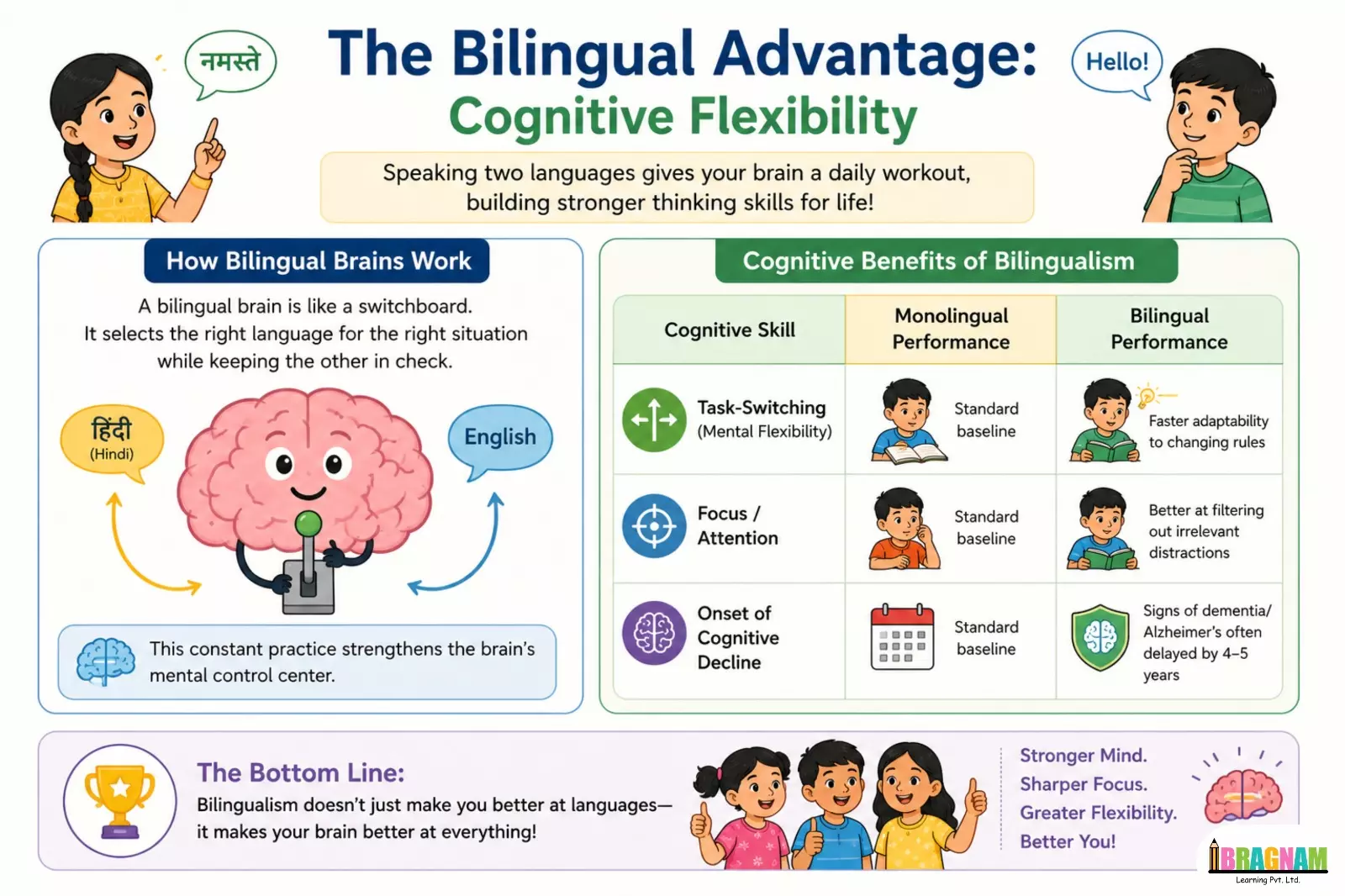
Bilingualism provides a massive workout for the brain’s cognitive reserves. Because a bilingual person’s brain must constantly choose the right language for the right context while suppressing the other, it develops superior cognitive flexibility.
| Cognitive Skill | Monolingual Performance | Bilingual Performance |
| Task-Switching | Standard baseline | Faster adaptability to changing rules |
| Focus / Attention | Standard baseline | Better at filtering out irrelevant distractions |
| Onset of Cognitive Decline | Standard baseline | Signs of dementia/Alzheimer’s often delayed by 4–5 years |
5. Socio-Emotional Cognition and “Theory of Mind”
Cognitive development isn’t just about logic and memory; it’s also about understanding social landscapes. Around the age of 4, children develop what psychologists call Theory of Mind—the realization that other people have thoughts, feelings, and beliefs that are different from their own.
Language is the bridge that makes Theory of Mind possible.
- Emotional Labeling: When a child learns words like frustrated, anxious, or jealous, they move from feeling a vague physical sensation to understanding a distinct mental state.
- Perspective Taking: Conversations that involve mental-state verbs (“Why do you think she is sad?” or “He believes the toy is hidden”) explicitly teach children to model the minds of others, boosting empathy and social intelligence.
Nurturing the Connection: Actionable Tips for Parents and Educators
Knowing how deeply language impacts the mind, how can we leverage this to support healthy cognitive growth?
- Engage in Conversational Turns: Don’t just talk at children; talk with them. Back-and-forth volleys of conversation are the single best predictor of future linguistic and cognitive success.
- Narrate Your Day: Talk through what you are doing. “I am cutting this carrot because we need small pieces for the soup so they cook faster.” This teaches cause-and-effect reasoning seamlessly.
- Read Actively (Dialogic Reading): Instead of just reading the text on the page, stop and ask open-ended questions: “What do you think will happen next?” or “How do you think that character feels?”
Conclusion: Words Build Worlds
The connection between language and cognitive development is a beautiful, symbiotic cycle. Language shapes our thoughts, and our thoughts expand our ability to use language. From the primitive self-regulation of a toddler to the sophisticated problem-solving of an adult, our cognitive architecture is profoundly linguistic.
By prioritizing rich, meaningful communication in our homes, schools, and daily lives, we aren’t just teaching people how to speak—we are unlocking their potential to think.