
Early Childhood education : Have you ever watched a toddler figure out how to stack a set of blocks, or seen the pure joy on a preschooler’s face when they finally learn to tie their shoes? These look like simple moments of play, but underneath the surface, something incredible is happening.
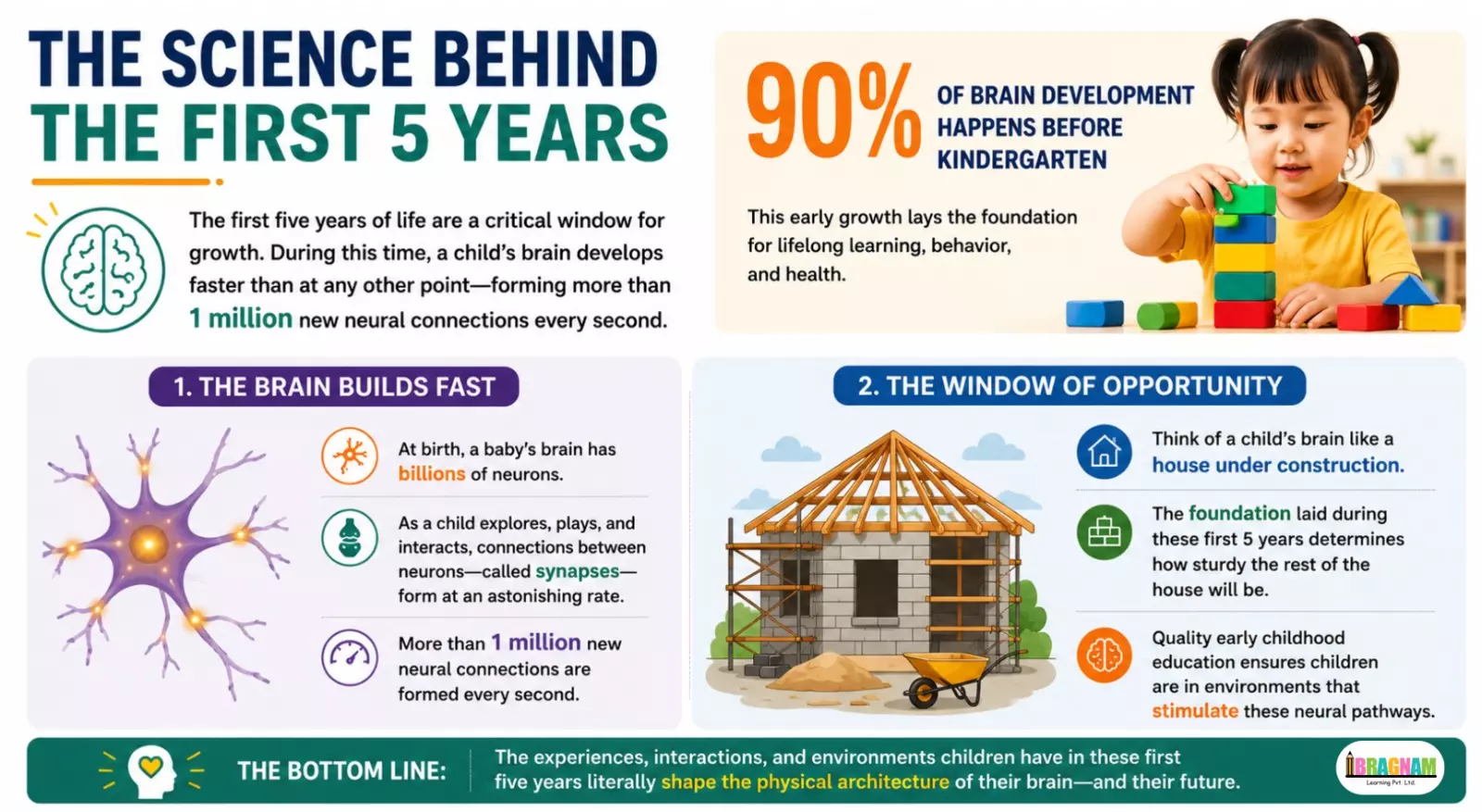
During the first five years of life, a child’s brain develops faster than at any other time. In fact, scientists tell us that 90% of brain development occurs before a child even steps foot into a kindergarten classroom.
This is why early childhood education isn’t just about preparing kids for school—it’s about preparing them for life. If you have ever wondered why those early years are so critical, or how structured learning impacts a young mind, you are in the right place. Let’s break down exactly why the first 5 years matter so much.
The Science Behind the First 5 Years
To truly understand why early childhood education is a game-changer, we have to look at the neurology.
When a baby is born, their brain is packed with billions of neurons. However, the connections between these neurons—called synapses—are relatively sparse. As a child explores the world, interacts with caregivers, and plays, these synapses form at an astonishing rate of more than 1 million new neural connections every single second.
The Window of Opportunity
Think of a child’s brain like a house under construction. The foundation laid during these first 5 years determines how sturdy the rest of the house will be. If the foundation is weak, adding a beautiful roof later on won’t fix the underlying structural issues.
Quality early childhood education ensures that children are placed in environments that stimulate these neural pathways. Whether it’s through sensory play, storytelling, or music, early learning literally shapes the physical architecture of the brain.
4 Lifelong Benefits of Quality Early Childhood Education
Many parents view early learning centers or preschools as glorified daycare. But the reality is that high-quality programs offer structured, research-backed benefits that pay dividends for decades.
1. Advanced Cognitive and Language Development
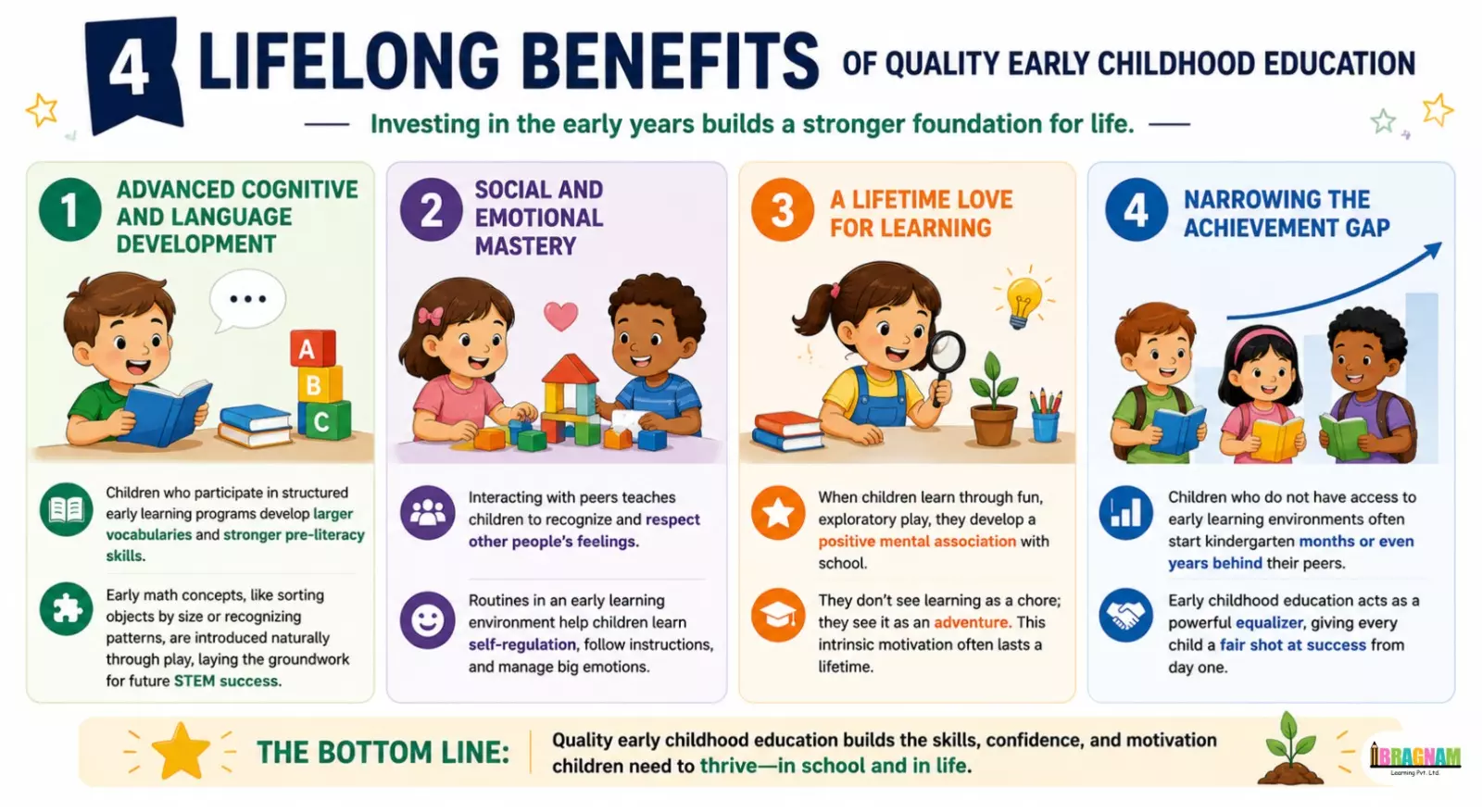
Children who participate in structured early learning programs generally develop larger vocabularies and stronger pre-literacy skills.
- Rich Verbal Environments: Teachers in high-quality settings intentionally expose children to a massive variety of words, sentence structures, and interactive reading.
- Problem-Solving Skills: Early math concepts, like sorting objects by size or recognizing patterns, are introduced naturally through play, laying the groundwork for future STEM success.
2. Social and Emotional Mastery
Learning how to share, take turns, and manage big emotions doesn’t come naturally to a toddler. Early childhood education provides a safe, supervised sandbox for kids to build their emotional intelligence.
- Empathy Building: Interacting with peers teaches children to recognize and respect other people’s feelings.
- Self-Regulation: Routines in an early learning environment help children learn how to transition between activities, sit still for short periods, and follow simple instructions without throwing a tantrum.
3. A Lifetime Love for Learning
When children are introduced to learning through fun, exploratory play at an early age, they develop a positive mental association with school. They don’t see learning as a chore; they see it as an adventure. This intrinsic motivation often sticks with them all the way through college and into their careers.
4. Narrowing the Achievement Gap
Studies show that children who do not have access to early learning environments often start kindergarten months or even years behind their peers academically. Unfortunately, catching up becomes incredibly difficult as time goes on. Early childhood education acts as a powerful equalizer, giving every child a fair shot at success from day one.
What Does Good Early Learning Look Like?
It’s a common misconception that early schooling means forcing three-year-olds to sit at desks and memorize flashcards. In fact, that is exactly what it shouldn’t look like.
Effective early learning centers focus on play-based learning.
Play is often talked about as if it were a relief from serious learning. But for children, play is serious learning.” — Fred Rogers
In a quality program, teachers act as facilitators. They observe what children are interested in and build educational activities around those interests. If a toddler is obsessed with dinosaurs, the teacher might use dinosaur figurines to teach counting, or read a book about fossils to introduce new vocabulary words.
The Economic and Social ROI: A Smart Investment
The impacts of investing in the first five years extend far beyond the individual child. Economists have studied the long-term return on investment (ROI) of public spending on early childhood education, and the data is staggering.
- High Financial Returns: For every single dollar invested in high-quality early childhood programming, society sees a return of up to $4 to $9 through reduced crime rates, lower special education costs, and higher future tax revenues.
- Higher Graduation Rates: Adults who attended preschool are statistically more likely to graduate high school, own a home, and earn higher salaries.
When we prioritize the early years, we aren’t just helping families; we are strengthening our entire economic future.